Decline of the Han dynasty
The Romance of the Three KingdomsThe Decline of the Han dynasty is a political unravelling in which imperial authority survives in name while control passes to those who command the court and the armies. Its decisive consequence is not simply the end of one ruling house: the struggle over who may legitimately wield the emperor’s authority gives shape to the competing claims of Cao Cao and Xuande, and finally to the emergence of Wei and the rival Han claim in Shu.
Court Capture and the Loss of Authority
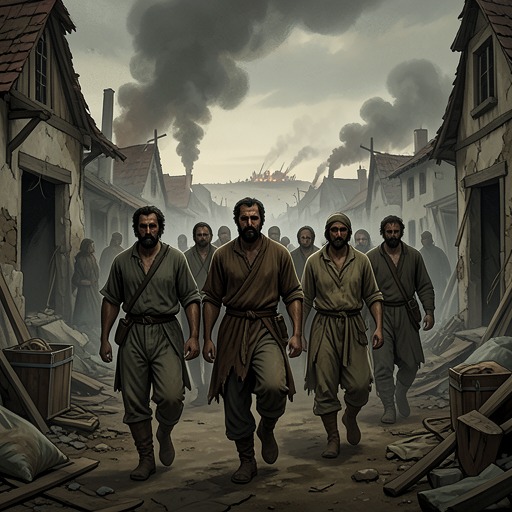
The decline begins within the palace. Under Emperor Huan, favour toward eunuchs weakens the place of ministers considered distinguished and principled. His successor, Emperor Ling, fails to support a conspiracy against them; its instigators are executed, and the eunuchs acquire unchallenged power at court. Even as signs of disorder trouble the reign, the emperor withdraws into the palace rather than answering warnings from loyal ministers. The Ten Imperial Attendants, led by Zhang Rang, take over, while discontent spreads across the empire and rebellion becomes increasingly likely.
This account treats the crisis as institutional as well as personal. A court unable to restrain its own dominant faction cannot command confidence beyond the palace, and the resulting erosion of authority leaves the empire vulnerable to armed challengers. The narrative places this court failure at the beginning of the larger fragmentation: rebellion does not arise in a political vacuum but in a realm whose governing center has already lost its capacity to respond.
Rebellion, Warlords, and a Fractured Empire
The Han’s division is set within a recurrent history of unity and rupture. Earlier, the Zhou empire was broken by warring kingdoms before Qin reunified it; after Qin fell, Chu and Han contended until the Han prevailed. A later uprising also divided the empire, but Emperor Guang Wu restored unity. The crisis under Emperor Xian therefore appears as another turn in a dynastic cycle, though this time the empire divides into three kingdoms.
The account describes the end state as a China broken into a dark world governed by warlords and violent strongmen. Three leaders rise from that fragmentation: Xuande, Cao Cao, and Sun Quan. Each establishes a dynasty and carves out a kingdom from the weakening Han realm. The change is thus both territorial and dynastic: the old empire does not simply lose control to one successor, but gives way to three competing political centers.
The Emperor as a Source of Legitimacy
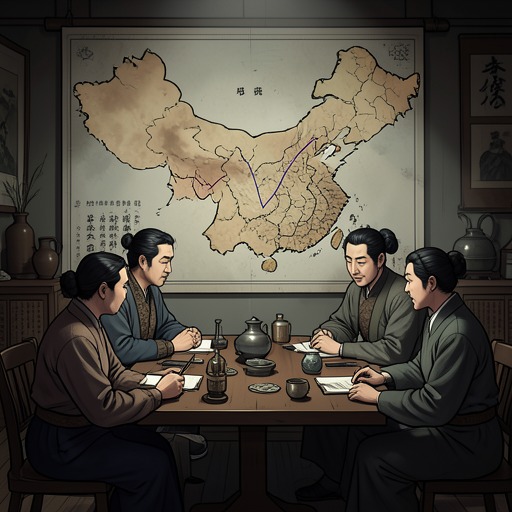
Although the Han court has lost independent power, the emperor remains politically valuable. Kong Ming’s assessment of the balance of power makes this explicit: Cao Cao commands a vast army, has overcome Yuan Shao through cunning, and controls the Son of Heaven. Possession of the emperor brings the allegiance of many nobles, making Cao Cao difficult to oppose directly. Imperial authority has become an instrument in the hands of the strongest warlord, but its symbolic force remains potent enough to strengthen his position.
That tension also shapes Xuande’s resistance. When an adviser argues that Cao Cao’s dominance proves the Mandate of Heaven has moved away from the Han, Kong Ming answers through the obligations of loyalty and filial piety. In his view, a servant of the Han must help remove a minister who abuses power; Cao Cao’s strength does not itself make him a rightful successor. The dispute shows that the dynasty’s decline is also a struggle over interpretation: military control may indicate power, but the narrative leaves open whether it can confer legitimate rule.
The Han’s Formal End and Competing Claims
At Cao Pi’s accession, the Han’s loss of authority becomes official. The abdication announcement, issued in Emperor Xian’s name, declares that the Han era has ended and that fortune has passed to the Cao family. It invokes the example of Yao’s abdication to present the transfer as a rightful yielding of rule rather than a seizure. Cao Pi accepts the imperial seal before officials and soldiers, while the former emperor is reduced to the governorship of Shanyang.
The ceremony does not settle the question of legitimacy. In Chengdu, news of Wei’s founding and rumours about the former emperor’s fate distress Xuande. Kong Ming proposes that Xuande, as a descendant of the Han founder, become emperor and continue the lineage. Xuande initially regards the proposal as rebellious; Kong Ming argues instead that Cao Pi has usurped the throne and that Xuande has a duty to reclaim it. The Han’s decline therefore produces a divided legacy: its old court is displaced, yet loyalty to its name becomes the basis for a rival claim.
A Cycle of Political Failure
The later warning of Lü Kai gives the decline a retrospective measure. Addressing Sun Hao, he says that the Han collapsed and the Three Kingdoms arose from its ruins, and that the lines of Xuande and Cao Cao have also collapsed through abuse. His comparison connects the Han’s fall to a broader pattern in which political lineage cannot secure survival when governance fails. The crisis is not treated as a single transfer of power, but as a recurring vulnerability in which court capture, popular hardship, and the abuse of authority make dynastic claims precarious.